End Grain Cutting Board Cost: What You’ll Pay
An end grain cutting board usually costs about $60 to $300, with large hardwood boards often running about $200 to $500 or more; a DIY build often costs about $40 to $150 in materials. Buy the wrong size or wood, and you can overpay for a board that moves, dulls knives faster, or cracks. This guide breaks down price by size, species, labor, finish, and the real cost of building one yourself.
Typical cost range
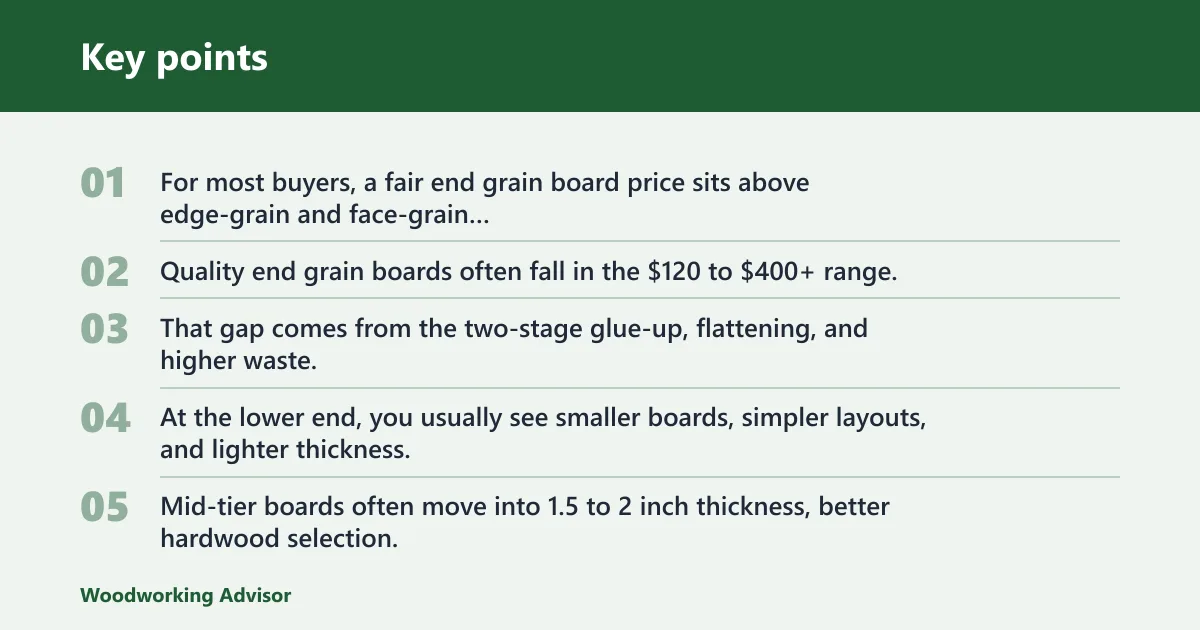

For most buyers, a fair end grain board price sits above edge-grain and face-grain boards because the build takes more labor and more careful lumber selection. Quality end grain boards often fall in the $120 to $400+ range, while edge-grain boards are usually $40 to $150. That gap comes from the two-stage glue-up, flattening, and higher waste.
What buyers get at each tier
At the lower end, you usually see smaller boards, simpler layouts, and lighter thickness. Mid-tier boards often move into 1.5 to 2 inch thickness, better hardwood selection, and more careful finishing. Premium boards tend to be larger, thicker, and built from walnut, cherry, or mixed-species layouts with extra labor in flattening and detailing.
This guide uses size, species, thickness, surface work, and upkeep to judge value. A board is not fairly priced just because it is end grain. The build details decide whether the asking price makes sense.
📊 This Old House lists the project cost as $20 when using scrap wood. Source: Thisoldhouse.
Why end grain boards cost more
End grain boards cost more because they take more steps and more careful handling than edge-grain or face-grain boards. The blade meets the wood fibers end first, which is why the surface is often described as kinder to knives. That same orientation requires a two-stage glue-up and more flattening work, which raises labor cost.
Two-stage glue-up and labor
Most end grain builds start with a first glue-up of strips, followed by cutting those strips into blocks and gluing them again with the end grain facing up. That second glue-up is where the knife-friendly surface comes from. It also adds time, clamp handling, and cleanup. This Old House lists the project time at 4 to 5 hours, and that is before any machine flattening or detailing. (Thisoldhouse)
Water-resistant or waterproof glue matters in both glue-ups. Common shop choices include Titebond II and Titebond 3. The glue line has to survive moisture exposure from normal board care, so adhesive choice is part of the cost, not a side detail.
Waste, flattening, and yield loss
End grain boards create more waste than a simple plank board. Cutting, flipping, and re-gluing consumes more stock, and flattening an end grain blank takes care because the surface can tear out. A planer, drum sander, belt sander, or jointer may be used during the process, but each adds setup time and machine wear. That is one reason a finished board costs more than the lumber alone.
Suppose a maker is pricing a medium walnut board. The lumber bill may look manageable, but the real cost rises after trimming away defects, flattening the blank, sanding through multiple grits, and applying a food-safe finish. The board price has to cover that labor.
Size and thickness price bands
Board size changes price in a direct way. Larger boards need more wood, more glue, more sanding, and more time to flatten. Thickness does the same, because a thicker blank uses more material and gives the board more resistance to warping and more life for future refinishing.
12×18 inches
A 12×18 inch board often sits in the entry to mid range if it is made from a common species such as hard maple. It works well for most home kitchens, especially for everyday slicing and serving. If the same size is built from walnut or cherry, the price usually moves up because material cost rises immediately.
14×14 inches
A 14×14 board is compact but square, so it suits smaller counters and prep tasks. Because the footprint is modest, the price can stay lower than a larger carving board, but a thick blank can still push it into the mid tier. A custom layout or a contrasting species pattern adds cost quickly.
16×22 inches and 18×24 inches
These are large workhorse sizes. A 16×22 board often fits serious meal prep, while 18×24 inches moves into premium territory because of wood volume and handling time. At these sizes, thickness matters even more, because a thin board can feel unstable and is more likely to move over time.
Thickness affects more than weight. WoodStuffHQ recommends a minimum thickness of 1.5 inches, and boards thinner than 1.25 inches tend to bow. In practice, 2 inches or more is usually the safer target for a heavy-duty board that will be used often and refinished later.
Wood species cost differences
Species changes both appearance and price. Hard maple is usually the value choice because it is hard and has tight grain. Walnut costs more because of its color and good durability. Cherry sits in the middle for many buyers. White oak can be used, but its open grain means it needs caution in end grain applications.
Hard maple
This Old House says maple is excellent because of its hardness and tight grain. That makes it a common choice for buyers who want a durable board without paying walnut prices. It is often the best match for a plain work board where performance matters more than color contrast.
Walnut and cherry
This Old House says walnut offers a dark color and good durability. Cherry is also listed as one of the best woods for end grain boards. Both usually carry a higher retail price than maple because the lumber cost is higher and the finished board is often sold as a furniture-grade kitchen item rather than a basic prep surface.
White oak and mixed species boards
This Old House warns that oak should be used cautiously because of its open grain structure. That does not make oak unusable, but it changes expectations. Mixed-species boards can add visual appeal, yet they often cost more because they require more sorting, cutting, and layout work. A striped board may look simple, but it can take longer to build than a single-species board.
How much does it cost to make one?
DIY cost depends on lumber choice, board size, waste, and whether you already have the flattening tools. A scrapwood build can be very low cost. This Old House lists a project cost of $20 when using scrap wood. For a nicer hardwood board, material cost often lands in the $40 to $150 range, especially once glue and finish are included.
Material cost breakdown
The biggest material cost is lumber. Hard maple usually sits below walnut, cherry often lands between the two, and mixed species can land anywhere depending on the cut list. Water-resistant glue, sanding supplies, and food-safe finish add smaller but real costs. A board that looks simple can still have a high lumber bill if the wood is dense, wide, or clear of defects.
Glue, finish, and flattening tools
Two glue-ups mean you use more adhesive than on a basic face-glued project. Titebond II or Titebond 3 is common because the board will be washed and re-oiled during its life. Finish usually means mineral oil or a mineral oil and beeswax blend. FixThisBuildThat lists both mineral oil and a mineral oil and beeswax blend as materials.
Flattening tools also change the build cost. A planer, drum sander, belt sander, or jointer may be used to true the blank. If you already own those tools, the cost is mostly time and consumables. If you do not, buying the board may be cheaper than outfitting a shop just for one project.
DIY versus buying a finished board
DIY makes sense when you already have lumber access, clamps, and flattening tools. Buying makes more sense when you want a predictable result, a flatter surface, and a finish that is ready to use. FixThisBuildThat treats end grain boards as an upgrade to normal edge grain boards, and that upgrade shows up in both labor and price.
| Board size | Thickness | Wood species | Estimated retail price band | Likely DIY material cost | Main cost driver |
|---|---|---|---|---|---|
| 12×18 in. | 1.5 in. | Hard maple | $60 to $120 | $40 to $70 | Entry-size board, common hardwood |
| 14×14 in. | 1.5 to 2 in. | Cherry | $90 to $160 | $50 to $90 | Species price and thicker blank |
| 16×22 in. | 2 in. | Hard maple or mixed species | $160 to $300 | $80 to $130 | Wood volume and flattening labor |
| 18×24 in. | 2 to 3 in. | Walnut | $250 to $500+ | $120 to $150+ | Large footprint, premium species, waste |
These bands are most useful when you compare a board against the same size, thickness, and wood. A 12×18 maple board and a 12×18 walnut board are not the same product, even if they look similar in a listing photo. Price should move with the build details.
What price should I sell my end grain cutting boards for?
For a 13 x 14 inch end grain board at about 1.5 inches thick, a sensible selling range is often around $90 to $220 depending on the wood species, finish quality, and local market. Add more if the board has engraving, a juice groove, a routed edge, or a complex pattern.
Add-ons that raise price
Custom engraving takes setup time and can create waste if a board is rejected after finishing. Juice grooves add machining time and can reduce the usable face area. Edge profiles and specialty shapes raise labor too. None of those should be treated as free features.
When custom work makes sense
Custom work makes sense when the buyer wants a gift piece, a matching kitchen look, or a specific size that a catalog brand does not offer. It also makes sense for serious knife owners who want a thicker board and a better species choice. Batch production can lower the per-board cost for a seller, because setup time is spread across several boards instead of one.
Picture a buyer who wants a 13 x 14 board for a countertop with limited space. If the seller uses 1.5 inch walnut, adds a clean bevel, and applies a proper finish, the board should not be priced like a small maple slab from a big-box shelf. The custom dimensions and species justify the higher price.
Frequently asked questions
How much do wood cutting boards cost?
Wood cutting boards usually range from about $20 for very basic or scrapwood projects to well over $300 for large hardwood end grain boards. Edge-grain boards are often cheaper, while end grain boards sit higher because they take more labor, more wood, and more flattening time.
How much does it cost to make an end grain cutting board?
A DIY end grain board often costs $40 to $150 in materials for hardwood builds, though scrapwood projects can be lower. Lumber is the main cost, followed by glue, finish, and sanding supplies. If you need to buy flattening tools or clamps, the real cost rises fast.
How much does a good wood cutting board cost?
A good wood cutting board often costs $60 to $300, depending on construction and size. For end grain boards, the better values usually sit in the middle of that range, where you get enough thickness, a sound species choice, and a finish that is easy to maintain.
Are end grain cutting boards better?
They are often a better choice for knife care because the blade meets the fiber ends rather than slicing across long fibers. That said, they are heavier, more expensive, and more maintenance-sensitive than many edge-grain boards. Better depends on whether knife care, appearance, or budget matters most.
How thick should an end grain cutting board
Minimum thickness is usually 1.5 inches, and 2 inches or more is often better for a board that will see regular use. Boards thinner than 1.25 inches tend to bow more easily. More thickness also gives you more sanding room over time.
Why are end grain cutting boards so expensive?
They are expensive because they use a two-stage glue-up, more lumber, more waste, and more flattening work than simpler boards. The price also rises with species choice, size, and finish quality. Large boards, especially in walnut or cherry, can move into premium pricing quickly.
Sponsored / affiliate links. As an Amazon Associate I earn from qualifying purchases. I may earn additional commission from eligible campaigns.