How to Thin Oil-Based Polyurethane: Ratios and Label Limits
Most oil-based polyurethane labels say not to thin it. Varathane’s data sheet says "Use full strength. Do not thin," and Minwax Fast-Drying Polyurethane says thinning is not recommended. If you thin anyway, mineral spirits is the solvent every sheet we read names, and the mix changes film thickness, recoat timing and fire risk. This guide covers the label limits, dilution math, a wipe-on method and the rag rules.
What the Can Says About Thinning Oil-Based Polyurethane
Best Pre-Thinned Wipe-On Pick | |
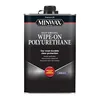 |
Minwax Oil-Based Wipe-On Polyurethane, Satin, 1 Quart, $25.99 This is the shortcut around everything below: Minwax already sells the thin, cloth-applied version, so you skip the mixing, the ratio guesswork and the label warnings about thinning the brush-on cans.
|
As an Amazon Associate we earn from qualifying purchases. | |
Before you reach for the mineral spirits, read the sheet for the exact product on your shelf. The ones below are the oil-based finishes people most often ask about, and only one of them welcomes a splash of solvent. Everything in this table comes from the manufacturer’s own technical data sheet or FAQ, not from forum rules of thumb.
| Product | Thinning guidance | Recoat time | Where it comes from |
|---|---|---|---|
| Varathane Interior Oil-Based Polyurethane | Use full strength. Do not thin. | 4 hours | Rust-Oleum data sheet VAR-01 |
| Minwax Fast-Drying Polyurethane | Thinning is not recommended | 4 to 6 hours | Minwax technical data sheet |
| Minwax Helmsman Spar Urethane (350 VOC) | Do not thin | 4 to 6 hours | Minwax technical data sheet |
| Minwax Wipe-On Poly | Sold already thin (29 to 31% solids) | 2 to 3 hours | Minwax technical data sheet |
| General Finishes Arm-R-Seal | Up to 10% mineral spirits | 12 to 24+ hours on raw wood | General Finishes FAQ and product page |
Two things stand out. First, the brush-on products agree with each other: no thinning. Second, the one product built to be wiped on is not a thinned brush-on can at all, it is a separate formula sold thin on purpose. That is the real choice most people face: thin a brush-on poly yourself against the label, or buy a finish designed for the cloth.
Why the Labels Say No: Thick on Purpose
Minwax explains it in a special note on the Fast-Drying sheet: the product is formulated to meet environmental limits on volatile organic compounds, so it carries more resin and a thicker consistency than ordinary polyurethanes, and the maximum VOC is 450 grams per liter. Our reading is that adding mineral spirits puts back solvent the formula was designed to leave out, so the can you thinned is no longer the product the label describes. The film thickness and dry times printed on it may no longer apply to your mix.
The viscosity numbers on the sheets show how different these products are. The table below puts them side by side.
| Minwax product | Viscosity (centipoise) | VOC ceiling (g/L) | Dry film per coat |
|---|---|---|---|
| Fast-Drying Polyurethane, gloss | 60 to 100 | 450 | Not listed on the sheet |
| Fast-Drying Polyurethane, semi-gloss and satin | 150 to 250 | 450 | Not listed on the sheet |
| Wipe-On Poly | 15 to 35 | 600 | 0.25 mil |
That is the myth worth correcting. Wipe-on poly is not simply the brush-on can with a quick splash of thinner: its listed viscosity is a small fraction of the satin brush-on can’s, and its VOC ceiling is higher. The table also shows that gloss and satin cans are not the same thickness, so a ratio that works in one sheen may not transfer to another. Always test the exact sheen you bought.
The Dilution Math Most Guides Skip
Ratios like "3 to 1" mean little until you know what is left in the mix. Varathane’s data sheet lists 42% solids by volume for its interior oil-based polyurethane, solids being the part that stays behind as the dried film. Diluting by volume simply multiplies that number by the share of polyurethane in the mix. This is our own arithmetic from the sheet, not a manufacturer figure, and other brands start from different solids.
| Mix (polyurethane : mineral spirits) | Mineral spirits share | Approximate solids by volume | Where it sits |
|---|---|---|---|
| Straight from the can | 0% | 42% | Label use, brush |
| 10 : 1 | 9% | about 38% | Near General Finishes’ 10% ceiling |
| 4 : 1 | 20% | about 34% | Light thinning |
| 3 : 1 | 25% | about 31.5% | Close to Minwax Wipe-On Poly’s 29 to 31%* |
| 1 : 1 | 50% | 21% | Very thin, wipe-on territory |
| 1 : 3 | 75% | about 10.5% | Closer to a wash than a finish |
*Minwax does not say whether its 29 to 31% is by weight or volume, so treat that match as a ballpark and not a recipe.
The second piece of math is film thickness. Dry film equals wet film times solids, which is why Varathane’s sheet pairs a 2.5 to 5.0 mil wet coat with 1.0 to 2.0 mils of dry film. Minwax lists 0.25 mil of dry film per coat for Wipe-On Poly. Comparing the two sheets, one brushed coat leaves as much film as four to eight wipe-on coats. Three wipe-on coats, the most the Minwax sheet describes, add up to roughly 0.75 mil, while Varathane’s minimum of two brushed coats adds 2 to 4 mils. These are different brands, so the comparison is approximate, but the direction is clear: a thinned finish is a thinner finish.
Varathane lists a recommended dry film of 1.0 to 2.0 mils per coat and 42% solids by volume for its interior oil-based polyurethane. Source: Rust-Oleum data sheet VAR-01
How to Thin Oil-Based Polyurethane With Mineral Spirits, If You Decide To
If you are going to depart from the label anyway, do it in a way that limits the damage. None of the steps below come from a brand’s mixing instruction, because the brush-on sheets give none. They are built from the label cautions we could verify and from basic measuring discipline.
- Read the can first. If it says do not thin, you are on your own, and any finish problem is yours to solve.
- Stir, never shake. Varathane’s sheet says to stir thoroughly before and during use and not to shake, to prevent bubbles in the finish. Stir the can before you pour anything out.
- Measure by volume in a clean container. Use a marked cup or a clean jar and keep the ratio exact, so you can repeat it or fix it.
- Start low. Ten percent mineral spirits is the highest figure we found from any manufacturer, so use that as your ceiling for a brush-on can, and go heavier only for wiping.
- Test on a scrap board of the same wood. Check flow, color and how long it stays tacky before you touch the project.
- Mix only what you will use today. Minwax’s label says not to transfer contents to other containers for storage.
- Label the jar and keep the lid on. Keep it closed when not in use, away from heat, sparks and open flames.
If your question is really about substitutes, our guide on thinning polyurethane with paint thinner covers that side, and paint thinner vs mineral spirits explains what the two are.
Wiping On Thinned or Pre-Thinned Polyurethane
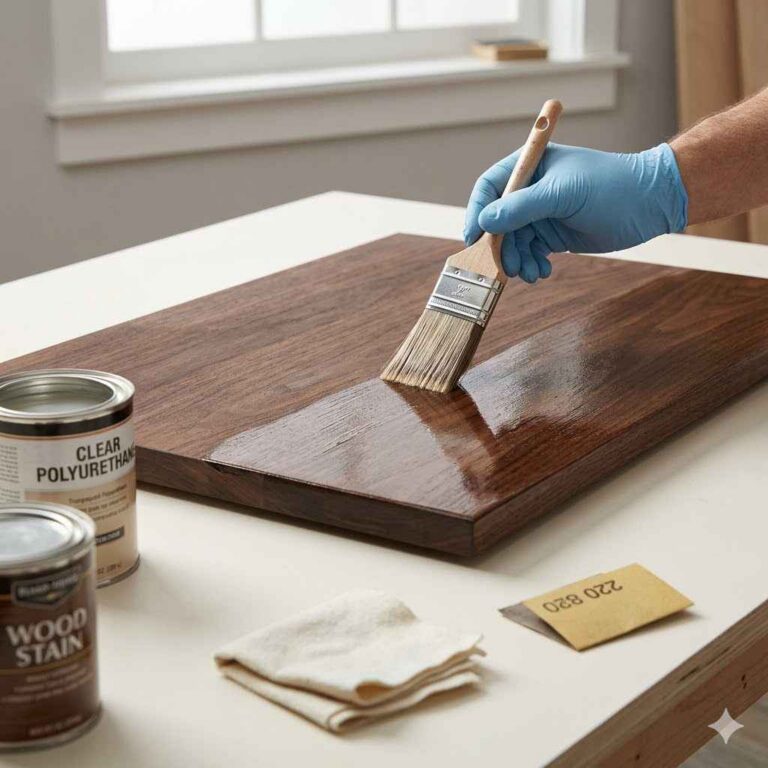
A rag or cloth is the one application method where thinning makes sense, because the point is a very thin, even coat. Minwax’s Wipe-On Poly sheet says to rub a small amount into the wood with a clean, soft, lint-free cotton cloth. It lists a 2 to 3 hour recoat, a light sanding with 220 grit or fine steel wool between coats, and overnight drying after the last coat. It also says to let stain dry fully, 24 hours, before wiping on poly.
- Cloth: clean, soft, lint-free cotton, per the Minwax sheet.
- Coat size: small amounts. The sheet’s dry film figure of 0.25 mil per coat only holds for thin coats.
- Between coats: sand lightly with 220 grit, remove all dust, then wipe on the next coat.
- Coats: two to three for the pre-thinned product. A homemade mix at 1 : 1 or thinner will usually need more to build any protection, which is our arithmetic and not a label claim.
- Floors: Minwax says its Wipe-On Poly is for interior surfaces except floors.
Recoat timing for a homemade mix is a gap in the published data. No sheet we read gives one, so use the product’s own recoat time as the minimum and rely on Minwax’s own test: sanding residue should be dry and powdery. If it is gummy or clogs the sandpaper, stop and wait longer. For brush technique, see our guide to the best way to apply poly to wood, and if you would rather skip oil-based finishes, see wiping on Polycrylic.
Brushing and Spraying a Thinned Coat
For brushing, Varathane’s sheet calls for a good natural bristle brush, recoating only when the previous coat has dried clear and hard, and a light sanding if any coat has dried more than 12 hours. It also sets the working range: air temperature between 55 and 90°F and relative humidity below 85%. Minwax adds that over-application, low temperature and high humidity increase cure time. Thinning does not change those limits. Spraying is a different job with its own settings, and none of the brush-on sheets give a spray ratio, so see our page on spraying Minwax polyurethane instead of guessing here.
Rags, Fumes and Fire: The Part You Cannot Skip
Thinned or not, oil-based polyurethane is a combustible product. Varathane’s sheet lists a flash point of 106°F (41°C), and the Minwax Wipe-On Poly sheet lists a flash point above 101°F and describes the contents as combustible. Minwax’s Fast-Drying sheet carries this label warning: rags, steel wool and other waste soaked with the product, and sanding residue, may spontaneously catch fire if improperly discarded. Its instruction is to place them immediately in a sealed, water-filled metal container and dispose of them under local fire regulations.
"Use full strength. Do not thin."
The National Park Service describes a real shed fire that started from a rag used to apply linseed oil, and says that for home projects you can spread soiled rags in a single layer on concrete so they become hard and brittle. Its page on spontaneous combustion is not specific to polyurethane, but the mechanism, a rag soaked with an oil-based product heating itself, is what the Minwax warning describes. Our full guide covers the safe disposal of oily rags in detail.
- Ventilation: Minwax’s label says to open windows and doors or otherwise ensure fresh air during application and drying. If you get eye watering, headaches or dizziness, increase fresh air, wear a NIOSH-approved respirator, or leave the area.
- Heat and flame: keep the mix and the rags away from heat, sparks, pilot lights and open flames.
- Sanding dust: the Minwax sheet says accumulated sanding residue may also ignite if not disposed of in a sealed, water-filled metal container.
- Never bundle rags: do not ball up wet rags in a bag, bin or pile.
What Thinning Will and Will Not Fix
People usually thin polyurethane to fix a symptom, and thinning only helps some of them.
- Brush marks and lap lines: a thinner coat can level better, and a wiped coat avoids brush marks entirely. Minwax’s floor guidance for brushing is to maintain a wet edge.
- Bubbles: usually caused by shaking the can, not thick finish. Varathane says do not shake for exactly this reason.
- Slow drying: Minwax says low temperature, high humidity, poor ventilation and thick coats all extend dry time, so fixing the room often beats adding solvent.
- Cloudy or milky film: a moisture problem, not a thickness problem. See how to fix a cloudy polyurethane finish.
- Amber tint on pale wood: thinning does not remove it. Minwax says its oil-based products can amber over light wood and suggests Polycrylic, and our oil vs water based polyurethane guide compares the two.
If you are working over stain, the order matters as much as the thickness, so check how to seal stained wood for wait times before the first coat of poly.
Frequently Asked Questions
Can you thin oil-based polyurethane?
Physically yes, but several major labels say not to. Varathane’s interior oil-based data sheet says to use it full strength and not to thin, and Minwax’s Fast-Drying Polyurethane sheet says thinning is not recommended. General Finishes is the exception among the sources we checked: its FAQ allows up to 10% mineral spirits for Arm-R-Seal. Check your own can first.
How much mineral spirits do you add to polyurethane for wiping?
No data sheet we read publishes a homemade wipe-on ratio, so any number is a starting point you must test. By our arithmetic from Varathane’s 42% solids by volume, a 3:1 mix of polyurethane to mineral spirits lands near 31.5% solids and a 1:1 mix near 21%. Mix a small cup, wipe a scrap board, and adjust.
Does thinning polyurethane make it dry faster?
Not in any way the manufacturers promise. Minwax states its dry times assume thin coats at 77°F and 50% relative humidity, and that thick coats extend dry time. A thinned coat is a thin coat, but no sheet we read gives a shorter recoat time for a homemade mix, so keep the label time as your minimum.
Can you store leftover thinned polyurethane?
Minwax’s label says not to transfer the contents to other containers for storage, so mixing only what you will use in one session is the safe default. General Finishes says its thinned Arm-R-Seal can be stored without separating, but that is one brand’s claim. Never leave rags from the job in a pile or a closed bin.
Can you use paint thinner instead of mineral spirits to thin polyurethane?
The labels we read name mineral spirits as the solvent and as the cleanup solvent, and Minwax lists paint thinner as an acceptable cleanup choice. Whether paint thinner is a safe substitute inside the mix depends on what is in your can, which our separate guide on thinning polyurethane with paint thinner covers.
Conclusion
The manufacturers’ own sheets say the brush-on products should not be thinned, so thinning is a choice you make at your own risk, and the evidence does not support any single magic ratio. If you want a thin, wipe-on coat, the cleaner path is a finish sold that way, such as the Minwax Wipe-On Polyurethane in the box above. If you do mix your own, keep it near 10% for brushing, test on scrap, and treat every rag as a fire hazard until it is dry or under water. The Minwax label wording quoted here comes from its Fast-Drying Polyurethane data sheet.
Sponsored / affiliate links. As an Amazon Associate I earn from qualifying purchases. I may earn additional commission from eligible campaigns.