Fiberglass Resin on Wood: Polyester vs Epoxy for Sealing
Yes, fiberglass resin can seal wood, but the label can mean polyester or epoxy, and the two behave very differently on wood. Polyester shrinks about 7% as it cures and gives off styrene fumes; epoxy shrinks less and is the resin the West System boat-building manuals recommend for wood. This guide covers which resin fits which job, how to apply it, the safety-data-sheet rules, and what topcoat to use.
Fiberglass Resin vs Epoxy: Which One Should Seal Your Wood?
Best Epoxy Pick for Sealing Wood
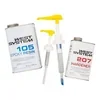 |
West System 105-A Epoxy Resin and 207 Clear Hardener Kit with Pumps A pumped 3:1 epoxy kit made for coating wood and wetting out fiberglass cloth, so you skip the styrene fumes and the MEKP catalyst that polyester resin needs.
|
For sealing wood, choose epoxy. Polyester works best when every layer is built and cured together, which is how many fiberglass boats are made. Boat repair and coating wood are secondary-bond jobs, where new resin goes on cured material, and that is where polyester falls behind. Gougeon Brothers, the makers of West System epoxy, write that polyester had been used for fiberglass repair "with mixed results" before epoxy took over. They sell epoxy, so read their comparisons with that in mind.
| Your job | Better resin | Why |
|---|---|---|
| Coating or sealing bare wood or plywood | Epoxy | Less shrinkage and better moisture resistance than polyester (West System manual) |
| Boat repair over cured polyester or fiberglass | Epoxy | In West System testing, an epoxy repair recovered 81.7% of laminate strength vs 70.5% for polyester |
| New build where all layers cure together | Polyester can work | Polyester performs fairly well when layers cure together as a primary bond (Gougeon Brothers) |
| Cutting boards, bowls, food surfaces | Neither | The polyester resin SDS below lists its recommended use as industrial, not food contact |
If you are coating wood before pouring or casting, our guide to sealing wood before epoxy resin covers the prep, and can you use epoxy on wood covers epoxy alone. This page is about the fiberglass and polyester side of the question.
Polyester vs Epoxy on Wood: The Numbers
Most articles stop at "epoxy is stronger." These are the figures that actually explain why. The polyester numbers come from the Epoxyworks comparison and one polyester resin SDS; the epoxy numbers come from the same article and a West System 105/207 product listing.
| Property | Polyester resin | Epoxy (West System 105/207) |
|---|---|---|
| Shrinkage during cure | About 7% by volume | Lower (no percentage given by the source) |
| Tensile elongation at failure | 1% to 2% for typical polyester | 3.5% to 4.5% |
| Film thickness for reliable cure | At least 15 to 25 mils (0.015 to 0.025 in) | Excellent thin-film cure |
| Styrene content | 40% to 50% by weight on the Fibre Glast Part 90 SDS | Not a styrene resin; listing says no VOCs and no solvent odor |
| Hardener | MEKP catalyst, amount set by temperature | 3:1 resin to hardener by volume, dispensed by pump |
| Working time at 72 F | Set by how much MEKP you add | 20 to 26 minute pot life |
| Cure | Depends on catalyst and temperature | Solid in 10 to 15 hours, full strength in 4 to 7 days |
Two things follow from the table. Wood swells and shrinks with humidity, and a coating that stretches only 1% to 2% before failing has less give than one that stretches 3.5% to 4.5%. That is our inference from the numbers, not a claim either source makes about wood. And the 15 to 25 mil minimum means a single thin brush coat of polyester may stay tacky instead of curing hard.
Styrene limits on one polyester resin SDS: ACGIH TLV-TWA 10 ppm, STEL 20 ppm; OSHA PEL 100 ppm, ceiling 200 ppm. Source: Fibre Glast Part 90 polyester resin SDS, 2024
Two common claims are worth correcting. Polyester is not mixed 1:1 with hardener; it is catalyzed with a small amount of MEKP, and cool weather calls for more catalyst than warm weather according to supplier US Composites. And "fully cured in 24 hours" is not a safe rule for either resin: the 207 epoxy kit above takes 10 to 15 hours to go solid and 4 to 7 days to reach full strength.
Safety: Styrene, MEKP, Fire and Skin Sensitization
This is the part most fiberglass-on-wood articles skip. The facts below come straight from two manufacturer safety data sheets (SDS) that we read: the Fibre Glast Part 90 isophthalic polyester resin SDS and the Fibre Glast Part 69 MEKP hardener SDS. Other brands classify their products differently, so always read the SDS for the can you actually buy.
| Product | What the SDS says | What to do |
|---|---|---|
| Polyester resin (styrene 40% to 50%) | Flammable liquid (H226); skin irritant; may cause an allergic skin reaction (H317); serious eye irritation; may cause respiratory irritation and drowsiness or dizziness; this SDS also lists suspected genetic defects and cancer (H340, H350) and organ damage from prolonged or repeated exposure (H372) | Chemical-resistant gloves, chemical goggles, protective clothing, and a NIOSH-approved respirator chosen for the exposure; use only in well-ventilated areas |
| MEKP hardener | Heating may cause a fire (H242); causes severe skin burns and eye damage (H314, H318); harmful if inhaled (H332); suspected of damaging fertility or the unborn child (H361) | Face and eye protection, keep in the original container, keep away from heat and combustibles |
| Mixing the two | Avoid direct contact of MEKP with accelerator; if you add a cobalt accelerator, mix it into the resin before adding the catalyst | Never combine catalyst and accelerator directly; add catalyst last |
- Sensitization is cumulative. The SDS says the resin may cause sensitization by inhalation and skin contact. A rash after repeated exposure is a reason to stop, not to tolerate.
- Vapors travel. The SDS warns that vapors can flow along surfaces to a distant ignition source and flash back, so keep pilot lights, sparks and open flames out of the area, and store the resin below 100 F.
- The respirator is not optional advice. The SDS tells you to base respirator selection on the exposure and the respirator maker’s guidance. A dust or cloth mask is not what it describes.
- Heat is a hazard in both systems. The polyester SDS says the resin can polymerize with heat if it is stored too warm. For epoxy, West System limits a single pour of its 205 Fast Hardener mix to about a quarter inch, because a larger mass heats enough to foam and weaken the epoxy. Mix small batches and spread them thin.
If you are unsure you can meet these conditions in your workspace, epoxy is the gentler option: the West System listing describes it as having no VOCs and no solvent odor, though you still need gloves and eye protection.
How to Seal Wood With Fiberglass Resin (Epoxy Method)
- Dry the wood first: West System advises letting wood equilibrate at 8% to 12% moisture content so it is dimensionally stable, the epoxy bonds better and moisture is not sealed in.
- Strip and sand: remove any flaking, chalking or blistering old finish, sand, then remove all the dust.
- Mix by pump: one stroke of 105 resin and one stroke of 207 hardener gives the 3:1 ratio. Do not eyeball it.
- Roll thin and tip off: thin films of 207 roll out and tip off smoothly, which means less sanding later. Add fiberglass cloth and wet it out if you want a reinforced shell.
- Let it cure: solid in 10 to 15 hours at 72 F, full strength in 4 to 7 days. West System says to assume amine blush has formed on any cured epoxy surface, and to wash it off with clean water and an abrasive pad before recoating, not solvent. The 207 hardener is listed as blush-free.
- Cover it: bare epoxy is vulnerable to rapid UV damage, so put a paint or clear varnish over it as soon as possible.
For the mixing itself, see our guide to mixing two-part epoxy for wood repairs, and if a batch stays gummy, epoxy not curing on wood walks through the causes.
If you use polyester resin anyway
Keep the coat at least 15 to 25 mils thick, work above 60 F, and follow the catalyst chart on your can. Supplier US Composites notes that polyester sold without wax leaves a tacky surface that can be recoated with little or no prep, and that the wax (sanding aid) should go in only your final coat so it sands easily.
Fiberglass Resin for Boats and Plywood

Boat work is where most fiberglass-on-wood questions start. West System’s manual shows sealing plywood edges with epoxy and reinforcing seams with fiberglass tape applied with epoxy, and says lesser grades of Douglas fir plywood may need a cloth layer to prevent grain checking. If you are choosing plywood for a wet project, compare it in our marine plywood vs pressure treated guide, and for soft or rotted spots see repairing wood rot with epoxy.
Teak and oily woods
Oily woods such as teak are a special case for any adhesive or resin. Our oily wood prep guide covers the surface prep before you coat or bond them.
Cutting boards and food surfaces
Do not use fiberglass or polyester resin on anything that touches food. The polyester SDS above lists its recommended use as industrial. For food-contact wood, follow how to seal wood for food instead.
What Topcoat Goes Over Fiberglass Resin?
Cured epoxy is not a finished surface outdoors. West System states that epoxy without a protective coating is vulnerable to rapid ultraviolet degradation and should be covered with an opaque paint or a clear varnish, and it adds that linear polyurethane (LP) paints bond well to cured epoxy. A varnish coat is a maintenance item: the same manual says to plan on a fresh coat every year or two. For general wood sealing questions, see does polyurethane make wood waterproof and how to seal wood after staining.
Frequently Asked Questions
Can fiberglass resin protect wood from water damage?
Yes, if the resin bonds and the wood is dry when you coat it. Epoxy is the better sealer because it shrinks less and resists moisture better than polyester, according to the West System boat-building manual. Wood should sit at 8 to 12 percent moisture content first, or the moisture gets sealed in.
Can you use polyester resin on wood?
You can, and it will harden into a glossy shell, but it is the weaker choice. Polyester shrinks about 7 percent as it cures, which stresses the bond line, and it needs a film at least 15 to 25 mils thick to cure reliably. Epoxy is the safer option for sealing wood that has to stay waterproof.
How long does fiberglass resin take to cure?
It depends on the resin, not a fixed 24 hours. One West System 105 and 207 epoxy kit lists a 20 to 26 minute pot life at 72 F, a solid cure in 10 to 15 hours and full strength in 4 to 7 days. Polyester cure time is set by how much MEKP you add and the temperature.
Is fiberglass resin safe to use indoors?
Not in a closed room. One polyester resin safety data sheet lists styrene at 40 to 50 percent, flags it as a flammable liquid that can cause an allergic skin reaction and respiratory irritation, and says to use it only in well-ventilated areas. Work outdoors or with strong cross-ventilation, and wear gloves, goggles and a suitable respirator.
Can you put polyacrylic or varnish over fiberglass resin?
Varnish and paint are the coatings the epoxy makers point to. West System says bare epoxy is vulnerable to rapid ultraviolet damage and should be covered with an opaque paint or a clear varnish as soon as possible. We found no manufacturer guidance for water-based polyacrylic over resin, so test it on a scrap coated the same way first.
Can you use fiberglass resin over old plywood?
Yes, if you prepare it. Strip flaking, chalking or blistering old finish, let the plywood dry to a stable 8 to 12 percent moisture content, sand and remove the dust before coating. West System notes that lesser grades of Douglas fir plywood may need a layer of fiberglass cloth to keep the grain from checking.
Conclusion
Fiberglass resin will coat wood, but for sealing it, epoxy is the better resin and polyester is the one that demands a respirator, ignition control and skin protection. Dry the wood to 8% to 12% moisture, mix by the ratio on the label, keep batches small, and put a UV-protective varnish or paint over the cured surface. Read the SDS for your exact product before you open the can.
Sponsored / affiliate links. As an Amazon Associate I earn from qualifying purchases. I may earn additional commission from eligible campaigns.