Wood Stain Remover: Which Type Actually Works (Pigment vs Dye)
A wood stain remover chemically dissolves the binder that locks a cured stain into the wood — but that only works on pigment-based stains. Dye stains bond directly to the wood fiber and shrug off every stripper; they need two-part wood bleach instead. That mismatch is the most common reason a stripper “does nothing.” This guide covers the three stripper chemistries, how to tell pigment from dye, deck-stain strippers, and how long each type really takes. If you only want the wood a shade or two lighter rather than fully stripped, see our guide to lightening stained wood for gentler options first.
Quick Answer
A wood stain remover is a solvent, caustic, or citrus-based gel that dissolves the binder holding cured stain to the wood so the softened finish scrapes off. It only works on pigment stains — dye that has soaked into the fiber needs two-part wood bleach. Solvent gels work fastest (2–30 minutes); citrus gels take up to 24 hours but are safest indoors.
What Is a Wood Stain Remover and How Does It Work?
Best Wood Stain Remover Pick
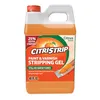
Citristrip Stripping Gel, 40 oz – $16.85
The citrus (d-limonene) formula matches the low-fume, indoor-safe chemistry covered above — and covered with plastic film it stays wet and active for up to 24 hours, letting one application lift multiple stain coats instead of several passes.
- Best for: Indoor furniture, cabinets, and antiques with kids or pets nearby
- Why we picked it: No methylene chloride or NMP, and safe with just an open window
- Main drawback: Needs hours, not minutes, to fully release a heavy multi-coat buildup
Compare more wood stain remover options
 Option 1 Sunnyside 2-Minute Remover Gel, Quart – $9.95
|
 Option 2 DEFY Exterior Wood Stain Stripper, 1 Gallon – $30.54
|
 Option 3 Sunnyside Multi-Strip ADVANCED, Quart – $14.97
|
As an Amazon Associate we earn from qualifying purchases.
A wood stain remover is a chemical gel or liquid that dissolves the resin binder holding stain pigment or dye inside the wood’s pores. Once that bond breaks, the stain lifts to the surface as a soft residue that a scraper, brush, or rag removes without cutting into the wood itself.
Every stain remover works through the same three-step mechanism regardless of chemistry: penetrate the finish, break the bonds holding it to the wood, then lift the dissolved residue to the surface. The active ingredient determines how fast that happens and what safety gear the job needs. A stain remover targets the binder, not the wood underneath — which is why gentle scraping, never sanding first, is the correct order of operations.
What Are the Types of Wood Stain Remover?
Wood stain removers fall into three chemistries: solvent-based (methylene-chloride-free formulas using NMP or dibasic esters), caustic (sodium hydroxide, also called lye), and biochemical (d-limonene citrus or soy-based). Solvent strippers work fastest and handle the most coats; caustic strippers are slower but effective on heavily built-up exterior surfaces; biochemical strippers are the lowest-fume, safest-indoor option.
| Type | Active ingredient | Typical dwell time | Fumes / VOC | Best for | Wood-damage risk |
|---|---|---|---|---|---|
| Solvent-based | NMP or dibasic esters (DBE) | 2–30 minutes | Moderate to high; ventilate | Multiple coats of paint, varnish, or thick stain buildup | Can over-soften soft woods (pine, cedar) if left past the label time |
| Caustic (lye) | Sodium hydroxide | 20–45 minutes | Low odor, but caustic burn risk on skin | Painted or heavily built-up exterior surfaces | Darkens tannin-rich woods (oak, cherry) if not fully neutralized — the same tannin reaction can be used intentionally to darken pine |
| Biochemical (citrus/soy) | D-limonene or soy methyl esters | 1–24 hours | Very low; usable with minimal ventilation | Furniture, cabinets, antiques, indoor work around kids or pets | Minimal chemical damage; still raises grain like any stripper |
Which Stripper Chemistry Fits Your Situation?
For just a fresh latex paint drip or splatter rather than a full stain-stripping job, a heavy-duty stripper is overkill — denatured alcohol can remove that kind of paint on its own without the stronger fumes or dwell time of a full stripper.
No single product list answers this correctly for every job — the right chemistry depends on where the piece lives and how many coats are on it, not just what’s cheapest at the store.
| Your situation | Recommended chemistry | Why |
|---|---|---|
| Indoor furniture with kids or pets in the house | Biochemical / citrus | Lowest fumes; safe to use with minimal ventilation |
| Antique or valuable piece | Biochemical / citrus, tested on a hidden spot first | Gentlest on old, dry wood; lower risk of over-softening |
| Exterior deck or fence, 2+ coats of solid stain | Caustic or heavy-duty solvent | Built to cut through thick, weathered exterior coatings |
| Quick single-layer touch-up | Fast solvent gel | Shortest dwell time; done in one session |
| Softwood (pine, cedar) | Caustic or biochemical, not a fast solvent | Fast solvents can over-soften soft fibers if dwell time runs long |
Why Didn’t My Wood Stain Remover Work? (Pigment vs Dye Stains)
A stripper that “does nothing” usually isn’t defective — it’s facing the wrong kind of stain. Strippers dissolve the resin binder that glues pigment particles to the wood surface. A dye stain has no binder to attack: its color molecules are small enough to soak into the wood and bond directly to the cellulose fiber, so the stripper wrinkles off the clear topcoat and leaves the color in the wood untouched.
The tell is simple: after a full dwell time the finish scrapes off, but the wood underneath stays evenly colored with no film left to lift. That even, in-the-wood color is dye, and re-stripping won’t move it. Only two-part (A/B) wood bleach — or pool-strength chlorine bleach in milder cases — breaks dye color; our wood bleach guide walks through both. Oxalic acid, the third bleach type, only lifts rust and water marks — it won’t touch dye either.
| What’s actually on the wood | Will a chemical stripper remove it? | Correct method |
|---|---|---|
| Pigment stain (most oil- and water-based wiping stains, deck stains) | Yes — the stripper dissolves the binder | Solvent, caustic, or citrus stripper, then a light sanding |
| Dye stain (aniline dye, “penetrating” interior stains) | No — dye bonds to the wood fiber itself | Strip any topcoat first, then two-part wood bleach |
| Combination stain (pigment + dye in one can) | Partially — pigment lifts, a color ghost stays | Stripper first, then bleach the remaining color |
| Clear topcoat only (poly, varnish, lacquer) | Yes | Stripper alone does the whole job |
| Color still visible after stripping and bleaching | — | Sand — the color sits deeper than chemistry reaches |
Many hardware-store stains are combination products — pigment plus dye in one can — which is why a stripped surface so often keeps a faint, even ghost of the old color. That ghost is the dye fraction. For dark or blotchy leftover color, our guide on removing dark stain from wood gives bleach ratios by wood species.
Does Wood Stain Remover Damage the Wood or Raise the Grain?
Yes — nearly every chemical stripper raises the wood grain, because moisture in the gel swells the wood fibers as it works. This is normal and expected, not a sign of damage. A light sanding pass afterward, never before, restores a smooth surface, and citrus-based strippers tend to raise the grain less than solvent or caustic types.
Grain raising happens because the water or citrus-oil carrier swells wood fibers as the gel penetrates — the same reaction that occurs whenever a water-based product touches raw wood. It is not chemical damage and doesn’t need to be prevented, only sanded out afterward.
Plan the sanding around the chemistry: citrus gels stand wet on the surface for hours and raise grain the most — budget a 120-grit pass followed by 180 to get back to smooth — while fast solvent gels leave less standing moisture and usually need only a light 180–220-grit finish pass.
Is Wood Stain Remover Safe to Use Indoors, Around Kids and Pets?
Biochemical, citrus-based strippers are the safest option for indoor use around kids and pets — they contain no methylene chloride and produce minimal fumes. Solvent and caustic strippers need open windows, a fan, and nitrile or neoprene gloves; keep children and pets out of the room until the stripped surface is fully rinsed and dry.
Since May 2025, methylene chloride can no longer be legally sold to consumers for paint and coating removal, under an EPA rule finalized in April 2024, so current retail stain removers are already formulated without it. Low-VOC and citrus-based products still carry a caution label — they are safer, not non-toxic — so treat every stripper with the same basic protection: nitrile or neoprene gloves, safety glasses, and a respirator rated for organic vapors in an enclosed room.
Keep pets off the stripped surface until it has been rinsed with the neutralizer or water the label specifies and has fully dried, typically 24 hours.
How Long Does Wood Stain Remover Take to Work?
Dwell time ranges from 2 minutes to 24 hours depending on chemistry. Fast solvent gels soften a single coat in 2–10 minutes; standard caustic and solvent strippers need 20–45 minutes; citrus-based gels stay wet and active for up to 24 hours, letting them lift multiple coats in one application instead of several passes.
Expect a trade-off either way: fast solvent gels list 2–10-minute working times but flash off quickly, so a heavy buildup often needs a second coat before the wood is clean, while a citrus gel kept wet under plastic film can work through the same buildup in one long overnight application. Wipe citrus residue down with mineral spirits before sanding — the gel leaves an oily film that clogs sandpaper if skipped.
How Long Can You Leave Citristrip On? (Label vs Reality)
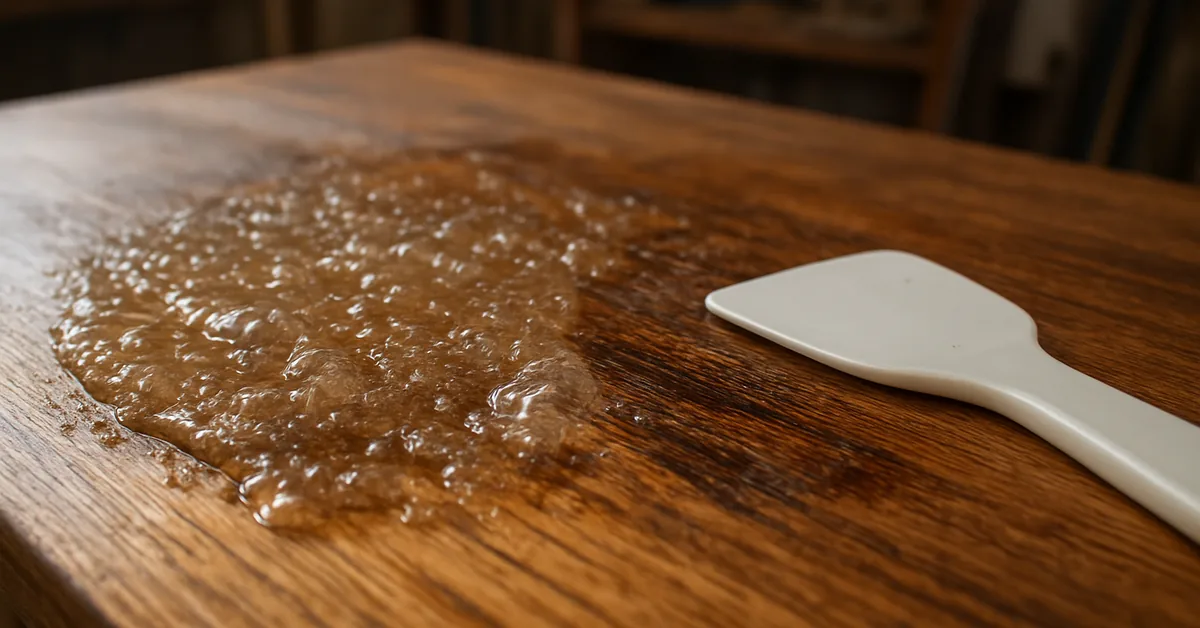
Citristrip’s label lists a 30-minute minimum, but the manufacturer states the gel keeps stripping for up to 24 hours as long as it stays wet — once it dries, it stops working and has to be reapplied. On a multi-coat finish, the realistic working window is hours, not the label’s half hour.
The fix for evaporation costs almost nothing: lay plastic film (kitchen wrap or a cut-open trash bag) directly over the wet gel. The film blocks evaporation, keeps the citrus solvent in contact with the finish, and lets one application work through several coats overnight instead of needing two or three passes. Temperature matters too — cold slows the reaction, so an unheated winter garage sits at the slow end of the range. Stripping a small item instead of furniture? See how long to leave Citristrip on a tumbler.
Does a Wood Stain Remover Work the Same on Old, Cured Stain as on a Fresh Stain?
No — a fully cured wood finish and a fresh stain mark are different problems needing different products. A stain remover is for cured, applied wood finish (the colored coating itself); a fresh spill or water/heat mark on already-finished wood is a surface blemish that usually lifts with mineral spirits, an iron, or a mild soap-and-water scrub instead.
The phrase “stain removal” covers two different jobs, and confusing them wastes time. Stripping a cured finish means dissolving the pigment or binder layer down to bare wood with the chemistries above. Removing a fresh mark — a water ring, a heat spot, or a fresh spill — means lifting a surface blemish without touching the finish underneath, which is a gentler, different process.
If the project is a fully cured oil-based finish, see removing a cured oil-based finish. For a water-based finish, see lifting a water-based finish. For gel stain specifically, see our gel stain removal guide.
How Do You Use a Wood Stain Remover Safely?
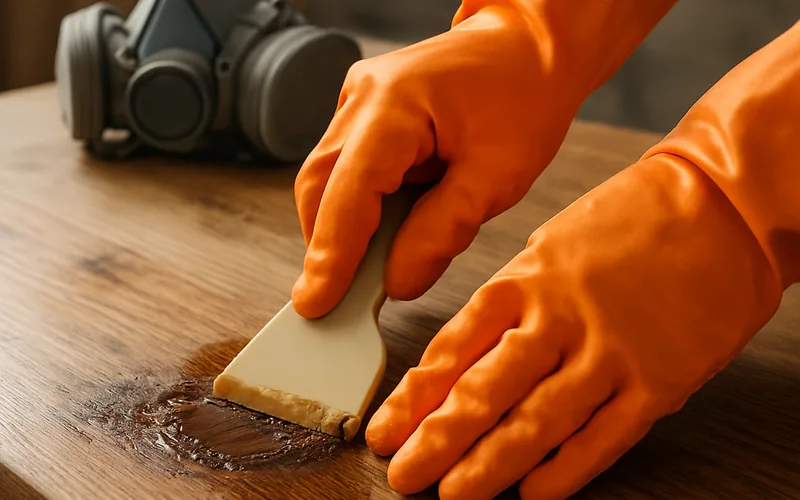
Applying a wood stain remover safely takes six steps: ventilate the space, protect skin and eyes, apply a thick even coat, let it dwell per the label, scrape with the grain, then neutralize and sand. Skipping the dwell time or scraping against the grain are the two most common mistakes that leave stain behind or scratch the wood.
- Ventilate the room or move the piece outdoors; open windows and run a fan blowing air out, not just around the room.
- Put on nitrile or neoprene gloves, safety glasses, and a respirator rated for organic vapors if working indoors.
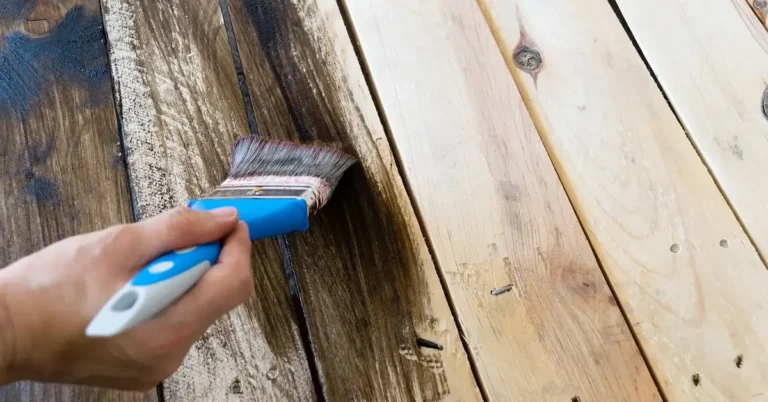
- Apply a thick, even coat with a natural-bristle brush — thin coats dry out before they finish working.
- Let the product dwell for the time on the label (2 minutes to 24 hours depending on chemistry); test a small edge rather than going by the clock alone.
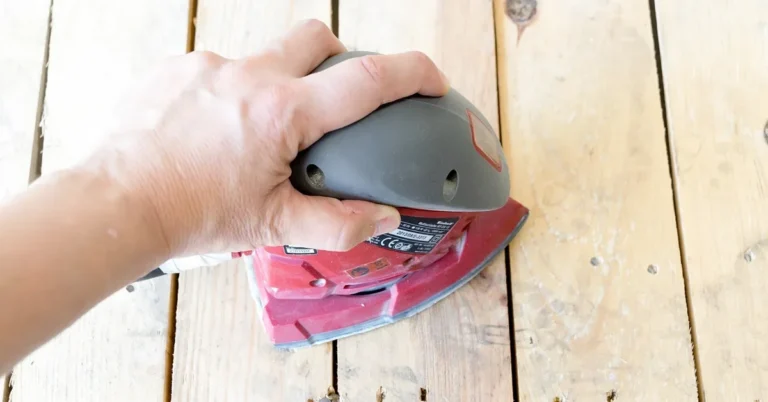
- Scrape with the grain using a plastic or wide putty-knife scraper; a sharp metal scraper can gouge softened wood.
- Neutralize per the label — a water rinse for citrus or solvent types, a vinegar-water wash for caustic strippers — then let the surface dry 24 hours before sanding with 120-grit, followed by 180 or 220-grit.
What About Deck and Exterior Stain Removers?
Exterior stain strippers are a different product class from furniture strippers: nearly all are caustic (sodium hydroxide) formulas sold as deck stain strippers, built to break down weathered semi-transparent and clear coatings across hundreds of square feet and then rinse off with a garden hose or pressure washer.
DEFY’s Exterior Wood Stain Stripper is typical of the class — sodium hydroxide plus sodium metasilicate, a 10–15 minute dwell, a scrub with the grain, then a thorough rinse. Restore-A-Deck sells the same job as a powdered concentrate that mixes into 5 gallons of stripper, the cheaper route on a big deck. Solid (opaque) stains are the exception: they behave like paint, and a heavy buildup usually needs the pressure-washing sequence in our guide to removing solid stain from a wood deck.
📊 One gallon of exterior stain stripper covers roughly 100–150 sq ft depending on how porous the wood is — Source: DEFY Stain Stripper label
“Any stripper not neutralized and thoroughly rinsed will cause poor coating adhesion.”
That neutralizing step is the one most people skip: caustic residue left in the wood keeps the surface alkaline, darkens tannin-rich species like oak and cedar, and makes the next coat of stain peel early. An oxalic-acid wood brightener applied within a day of stripping does both jobs — neutralizes the caustic and restores the wood’s natural color — before restaining. For the full sand-and-restain process once the old finish is off, see our guide to fixing stained wood.
What’s Changed With Wood Stain Removers Recently?
The biggest recent change is regulatory: the EPA finalized a rule in April 2024 banning methylene chloride from consumer paint and coating removers, with a compliance deadline of May 5, 2025, and a ban on most commercial uses by April 28, 2026. Every stain remover sold at retail today is formulated without this chemical.
Methylene chloride was the fastest-acting solvent stripper ingredient for decades but was linked to acute fume-related deaths and long-term cancer risk, according to the EPA. Its removal from the consumer market is why NMP, dibasic esters, and citrus-based formulas are now the standard fast-acting options instead. A narrow exemption remains for methylene chloride use in specialized furniture-refinishing shops with workplace protections through May 2029, but that applies to commercial refinishers, not products sold to homeowners.
Frequently Asked Questions
Can I make a wood stain remover at home?
A homemade mix of baking soda and mineral oil, or a vinegar-and-water solution, can lift some water-based surface marks, but neither breaks down a cured oil-based or polyurethane-sealed stain the way a commercial stripper does. For an actual finish-removal job, a citrus or solvent-based product works faster and more completely than any home mixture.
Does wood stain remover also remove paint?
Yes — solvent and caustic strippers are formulated to remove paint, varnish, lacquer, and shellac in addition to stain, since all of these are film-forming or pigmented coatings the same chemistry dissolves. Citrus-based gels handle paint and stain equally well but need the longer dwell time to fully release multiple coats. A fast-acting solvent gel like 2 Minute Remover Advanced works in as little as 2 minutes on paint and varnish instead.
What’s the difference between a stain remover and a paint stripper?
There is no practical difference — the same three chemistries (solvent, caustic, biochemical) are sold under both names, and most labels list “stain and varnish remover” or “paint and varnish stripper” interchangeably. Choose based on the chemistry and dwell time, not the label wording.
Do you have to reseal or refinish wood after stripping?
Yes — stripping removes the protective finish along with the color, leaving bare wood that needs a new stain (thinned to the right consistency for an even reapplication), sealer, or clear coat before it’s back in daily use. If the piece is a door, see our full wood door refinishing walkthrough for the sanding, filling, and interior-vs-exterior finish steps that follow stripping. Skipping this step leaves the wood exposed to moisture and staining again within weeks.
Can a wood stain remover be used on wood floors?
Yes, but working in sections is required — dwell time and fumes are harder to manage over a large floor than a single piece of furniture, and floors need a fan-assisted ventilation setup even with a low-VOC product. Test an inconspicuous corner first, since floor finishes often include a harder commercial-grade sealer that needs a longer dwell time.
Why is my wood stain remover not working?
The most common cause is a dye-based stain — strippers dissolve pigment binders but cannot touch dye that has bonded to the wood fiber, which needs two-part wood bleach instead. Other frequent causes: the coat was spread too thin, the gel dried out before it finished working (cover it with plastic film), or the room is too cold for the chemistry to run at label speed.
Will vinegar remove wood stain?
No — vinegar cannot break down a cured, sealed wood stain. It can lighten some fresh water marks and surface blemishes on finished wood, but its acidity also dulls shellac, lacquer, and oil finishes with repeated use. For a real finish-removal job use a citrus or solvent stripper, and for dye color left in the fiber use wood bleach.
Once the old finish is off and the wood is bare and sanded, the next decision is what to put back on it — our wood finishing guide breaks down every stain, oil, and sealer option for that step.
Sponsored / affiliate links. As an Amazon Associate I earn from qualifying purchases. I may earn additional commission from eligible campaigns.